Showing posts with label Graphene. Show all posts

14 February 2010

[Yet more] Researchers make faster-than-silicon graphene chips

Egad. A few hours after posting the graphene news from IBM, I encounter this apparently parallel development:

Researchers make faster-than-silicon graphene chips
updated 06:35 pm EST, Wed February 3, 2010
Penn State finds method of making graphene chips

A carbon semiconductor called graphene could replace silicon in computer chips in the near future, researchers at Penn State found. They claim to have developed a way to put the graphene on 4-inch wafers. The Electro-Optics Center Materials Division scientists say their work can eventually lead to chips that are 100 to 1,000 times faster than silicon.


Graphene is a crystalline form of carbon that is made up of two-dimension hexagonal arrays which is ideal for electronic applications. Attempting to place the material onto sheets using the usual methods turns them into irregular graphite structures, however. David Snyder and Randy Cavalero at Penn State say they came up with a method called silicon sublimation that removes silicon from silicon carbide wafers and leaves pure graphene.

A similar process has been used for graphene before, but the EOC is the first group that claims it has perfected the process to a point that lets them produce 4-inch wafers. The smallest wafers using a more conventional method have resulted in 8-inch graphene wafers. Typical wafers used for processors today are roughly 11 inches across. [via EETimes]

Big Blue demos 100GHz chip


Time to rev up this blog thingie again. Lots is going on, including some developments that seem quite practical for commercialization in the not-too-distant future.

Consider, from The Register in England:

Big Blue demos 100GHz chip


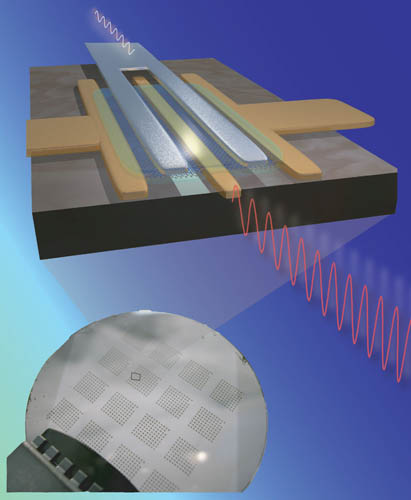
IBM reseachers have made a breakthrough in the development of ultra-high-speed transistor design, creating a 100GHz graphene-based wafer-scale device. And that's just for starters.
The transistor that the researchers have developed is a relatively large one, with a gate length of 240 nanometers - speeds should increase as the gate length shrinks.
The field-effect transistor that the IBM team developed exploits what a paper published in the journal Science understates as the "very high carrier mobilities" of graphene, a one-atom-thick sheet of carbon atoms grown on a silicon substrate.
This extraordinarily thin sheet is grown on the silicon epitaxially, meaning that it's created in an ordered crystaline structure on top of another crystaline structure - in this case, good ol' garden-variety silicon.

I wrote about graphene back in the Summer of 2007, noting it seemed more tractable for utilization in manufacturing processes than its more-glamorous siblings, carbon nanotubes. And so it seems: the fact that IBM's development is based on "garden-variety silicon" is a wonderful testament to recombinant innovation and promises practical adoption before too long. It seems hackneyed and threadworn to haul out Moore's Law one more time, but here it is again, keeping pace.

24 July 2007

Nanotubes' amazing little brother

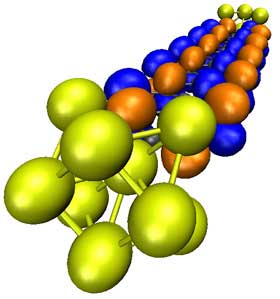
Think of graphene as a carbon nanotube slit lengthwise and laid flat, like a ribbon. First synthesized just three years ago, my sense from research reports to-date is that it may be more tractable as an interconnect material than nanotubes, and more readily manufacturable. As with carbon nanotubes, its electrical properties are remarkable, and it would not surprise me to see this material in microchips within a decade. If the process and manufacturing challenges can be licked--and they will be if the promise is what it seems to be--then the payback in terms of circuit speed and energy savings will be substantial. When you meet those gloom-and-doomers who beset every conversation with predictions of woe, just point them at this stuff, which looks likely to let us do more with less. Way more, with way less.
Researchers in both industry and academia are looking for alternative materials to replace copper as interconnects. Graphene could be a possible successor to copper, Nayak said, because of metallic graphene’s excellent conductivity. Even at room temperature, electrons pass effortlessly, near the speed of light and with little resistance, through metallic graphene. This would almost ensure a graphene interconnect would stay much cooler than a copper interconnect of the same size.